Monday, January 12, 2015

Landfills. Sort of....


Tupiza, Bolivia Landfill
Here in Tupiza, like many other Municipalities, refuse is taken to the local dump where it is....well, dumped. Just dumped. In the States, the EPA and other environmental governing agencies require landfills to apply a cover after each day of adding garbage. It is called Alternative Daily Cover (ADC) and it usually comprises of dirt, wood chips, industrial plastic scrap, even organics sometimes. The cover is meant to stop the escape of methane, and of course rouge flying plastics among other things.

In South America, I have yet to see a covered landfill. In this example, trash blows off the landfill every time the wind blows and debris can be found miles away form the landfill.
It makes one wonder why bother to collect garbage and bring it to a central location if it is bound to blow back into the surrounding landscape anyway? I often times find myself disgusted by the amount of litter in South America, but seeing such landfills makes me realize that sometimes throwing the item in the trash bin isn´t much better.
These folks are picking out the PET and stuffing it in SuperSaks. They were also picking out some clothing items. Unfortunately they declined to speak with me so I am not sure where they sell the PET and for what price. It was incredibly difficult to walk anywhere near this landfill as the flies and smells were overpowering. I have been around a lot of garbage and have certainly sorted through my fare share of trash and compost but I have a powerful respect for the people pictured above.


Tilcara, Argentina Landfill

No litter pickers at this landfill in Argentina. I have yet to see any plastics recycling efforts in the Northern part of the country. I assume it is the lack of any nearby market/buyer.
This landfill is in a river basin. When the water rises, it also picks up the plastics and other debris that has blow off this uncovered landfill. Again, it makes one wonder...what is the point of collection here? I saw a lot of glass here as it is one of the items that won´t blow or float away.

Tuesday, December 30, 2014

Bogota central recycling facility


Here is the Materials Recovery Facility (where they sort and bale incoming co-mingled recycling for market) I mentioned in the last post. 


"What an odd scale" I thought to myself before I realized that it was for the tow wheeled donkey carts, not the large trucks like we have in the US. Most scales I have seen in the states are all large enough to fit an 18 wheeler. 
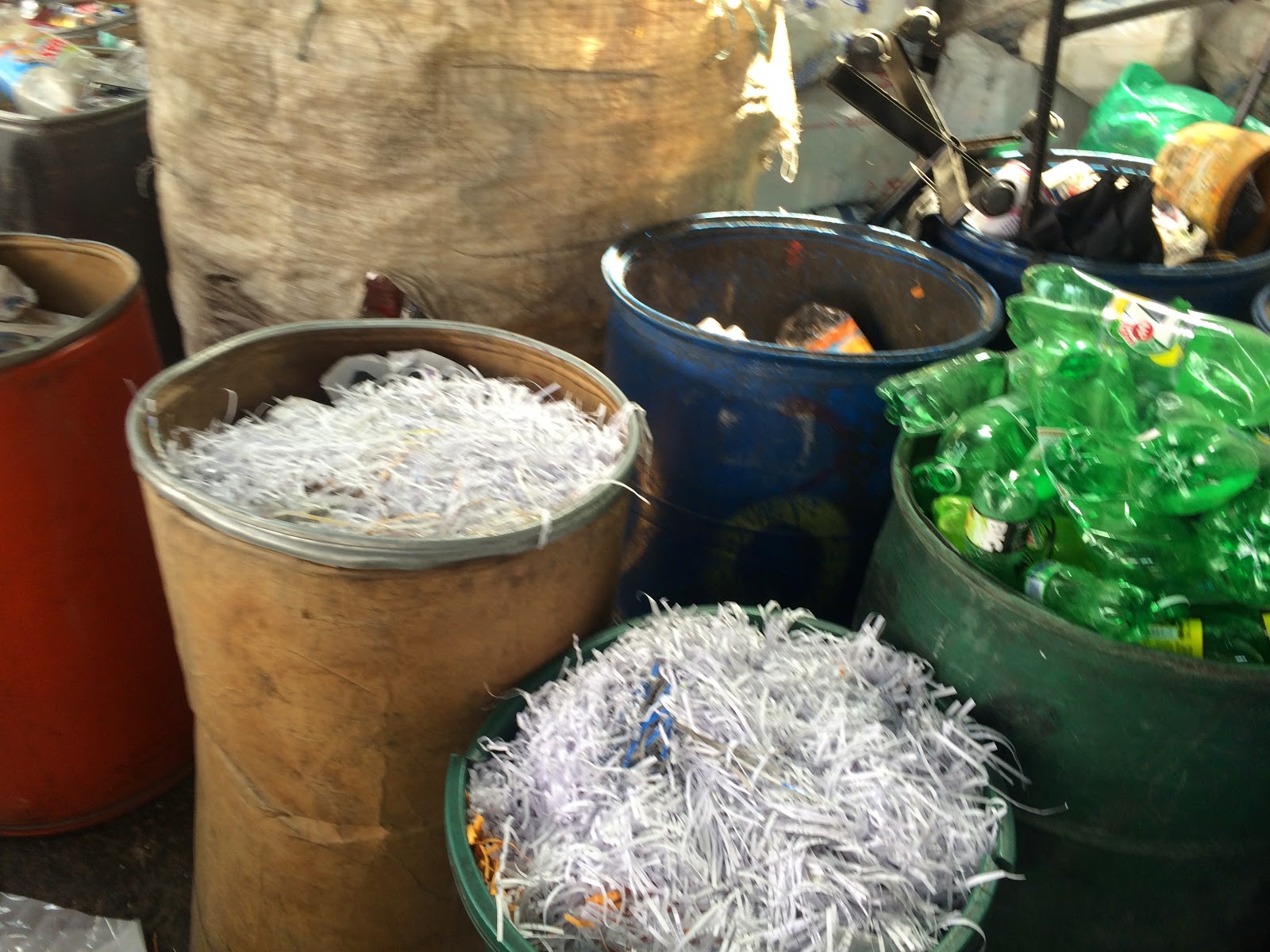
 Every commodity category is sorted here; by hand. Green PET from clear , Tetra pak, paper, shredded paper, rigid plastic, film clear, film mixed, aluminum, steal, etc…
 In many cities in the states there is no market for Tetra Paks, by no means do they fetch a good price here in Bogota, but at least they are recycling them.

  They even separate  out the clear PET that contained cooking oil. I believe it has a lower value than the normal PET (or at least keeps the normal PET price higher with it out of the mix), and there is so much food that is fried in cooking oil here, it may warrant its own stream.

 I loved this! I have never seen a bale bound together with twine in the States. All balers I have seen before use a metal cable. The baler in this facility puts this operations miles ahead of the rest of the recycling centers in Bogota, but it has its differences than the States.

Bales of Tetra Paks and more ready for market. 

Bogota recycling depot, the power of hand sorting.

This is Margdaula (or at least that is how I wrote her name down). She runs a recycling center in Bogota. This center happens to be right next to the largest and maybe only MRF (Materials Recovery Facility) in Bogota. The MRF next door is run by contractors under the Mayor’s office. Margdaula can pay a higher price for a lot of items than other recycling centers I visited as she is so close to one of the big buyer/sellers (the MRF next door).

She does some clever things here to maximize her profits. The most interesting being stripping all the PET she buys of caps and wraps. She tells me that this almost DOUBLES the price she can get for selling PET clear and Green.
How amazing is that? In the states we would never think to have a person physically do that task.
In Portland for example, the bottle bill collected PET is stripped of its caps and wraps at OR-PET in St. Helens and the non-PET is turned into its own mix of flake. I believe it is then sent to Denton Plastics in Gresham for the final stages of recycling and sold to buyers from there. In Portland we have somewhat of a solution for the caps and wraps, but in many cities around the world the caps and wraps devalue the PET stream.
I would say that is another great example of the power of the human hand in recycling.
In the west coast we believe we have a lot to show the world about recycling, but sometimes I´d argue the opposite. 


Saturday, December 20, 2014

Bogota depot

Here is a Mom and Pop recycling transfer station. As in this location buys materials by the Kilo from street recyclers and the the materials in larger amounts to the next buyer on the food chain, or directly to end market. 

Cardboard, PET, Film Plastic, Newspaper, Office Paper, Mixed Rigid Plastics. All these items have a price: meaning all these items are picked up off the street or out of garbage bags left for the garbage truck.


Friday, December 19, 2014

Bogota, Colombia. After hearing a lot about the industry in Bogota, I  had to make a detour there. 
 This was probably my favorite sight of the day; a bike picking up recycling. Garbage/Recycling trucks are incredibly fuel innefficent, averaging around 3-5 miles per desiel gallon. They create smog pollution and noise pollution, and they are horrible for the steets costing municipalites more money then they probably realize.
 Here is one of the hundreds of donkey carts used to collect recycling by independent street workers all over the city. They collect, sort, and bring their recycling to mom and pop buyers all over the city. People are hauling these carts around because last year the Mayor banned horses. I heard he gave some trucks to the bigger companies, but I see many people lugging these around, not so many trucks....at least there is less smog?
 Here is a street recycler I kept in touch with while in Bogota. His turf was the neighborhood where I was staying. He said he was making $0.036 a pound off of PET, still not a lot, but much better than any price I found in Peru. There must be healthier recycling markets here in Bogota. He collects glass, aluminim, plastic and cardboard.
 And again, the best of the best....REUSE.- Here my hostel collects empty glass soda and beer bottles and the items are picked up by a guy on a motor bike and taken back to the bottler. BETTER THAN RECYCLING
 Basura CERO, a Program launched by the Mayor last year. By no means is Bogota Zero Waste. A qualification meaning you achive a 90% waste diversion rate in the US. I believe Bogota is around 20%. You have to start somewhere.
Here, a recycler with a Basura Cero loggo on his cart (maybe he is somehow associated with the City´s program?) follows the garbage truck on its route collecting recycling before it goes into the trash truck and is lost forever. I saw many folks following the truck routes collecting recycling.

Plastic ball bit

Here in Ollantaytambo, a stop along Peru Rail before Machu Pichu, the municipal street workers collect and store the PET bottles here while cleaning the streets.
 I asked some locals where this ball pit of plastic ends up and was told Cusco or Lima. There are many recycling transferstations around Cusco, but I believe the final market (where the plastics bottle manufature is) is in Lima.
 Below is a recycling transfer station in a town called Puycara. From what I understood with my rough spanish is that they buy PET at $0.006 a lb. Not much but, and this is a huge but, they are buying it. There is no way I could walk into a Far West Recycling depot in Portland with PET slung over my back and actually get money for it. I am sure many other cities in the US also do not have recyclers buying PET off scrappers.
So the price is low, but they are buying it from individuals (most have a truck or motor bike to haul bottles in). The fact that there is value to the PET gives folks the insentive to collect it and bring it here. It has nothing to do with the environment, it is purly an economical force driving recycling in the Sacred Valley.
 A giant mountain of PET. The lady under the yellow tarp is sorting the green from the clear.
Beware of gaurd dogs. This was the first time I regretted not getting a rabies shot before my trip.

Machu Pichu

 Yes, welcome to the District of Machupicchu. Where we store our recyclables in lovely green tyveck bags all year round for the tourests to see.
 Another great storage unit filled with bags of recycling. Tons and tons of water bottles are sold in this town to the tourists climbing Machupichu and hanging around in Aguas Calientes. I did not see any toursits with their own refillable water bottle. Not many have the proper water filters or the means to boil their water....or perhaps they are lazy. The folks adminitrating Machu Pichu have lovely recycling recepticals dotting the land, how wonderfull that they will take the guilt off the consumer of the bottles. You would think more folks would notice these caches as EVERYONE passes them.
This last one also has a good amount of metel next to it. These locations are all along the road that the buses take up to Machu Pichu, and there is also one by the train tracks.
My guess is that the cost of labor to put these items on the train and get them out of Machupichu Town (Aguas Calientes) is far greater than the revenue they would receive in return for the plastic, metal, etc...
There happens to be a recycling facility I visted in a town on the rail line about 1.30hrs away, but stopping there might be inconvienent. Or perhaps no one has thought of doing it? It does not seem to be a top priority here in Machupichu town.